
Choirboy
Welterweight Contender Chuck Davey

CHOIRBOY
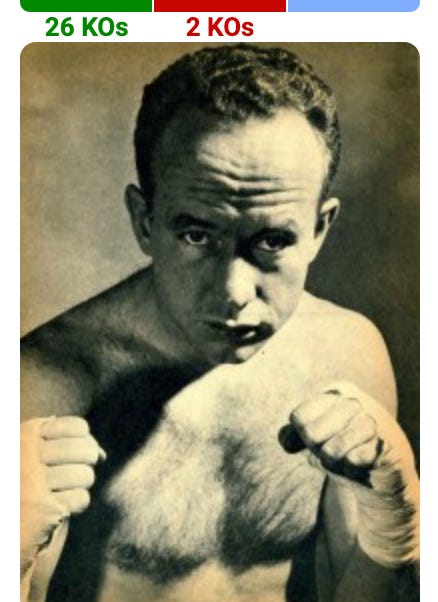
1950s welterweight contender Chuck Davey
He looked like a choirboy. Some people even believed if you looked close enough, you could actually see the halo glowing above his prematurely balding head. It would not be hyperbole to say that 1950s welterweight contender Chuck Davey was an outlier in the hurt business. Davey certainly didn’t need boxing to make his mark in the world. He had a college education and, his family was wealthy. And yet, unbeknownst to boxing fans worldwide, Davey was a mobbed-up fighter, although not by his own choice and, he was likely unaware of it, at first. Most mobbed-up fighters had no say in the matter. The Mob controlled boxing with an iron grip during the 1950s. The czars of boxing at that time were the twin cancers – Frankie Carbo and Blinky Palermo.
Charles Pierce Davey was born on May 3, 1925, to parents John Leon and Virginia Davey. Davey was born into wealth through his mother’s side of the family. He did not go into boxing, like many other fighters, to improve his lot in life. He was rich before he entered the ranks of professional pugilism. Davey was after glory and believed that boxing was his best route to achieve that goal.
His mother’s maiden name was Pierce, and her family owned a substantial amount of land in Oscoda, Michigan, on Lake Van Etten, beside the Wurtsmith Airforce Base. The Pierce family made their fortune by building cottages on land abutting Lake Van Etten. The area became known as “Pierce’s Point” and became extremely valuable.
Davey grew up with three siblings in very comfortable surroundings. The family never lacked for amenities or comforts. Davy’s older brother was named John Leo II, while his younger brother was Berten Edward, and his baby sister was christened Margaret. Davey spent his formative and adult years in the metropolitan Detroit area. He was privileged, along with his parents and siblings to have whiled away many happy, carefree summers in Oscoda, later called Oscoda Township. After his boxing career ended, Davey often took his wife Patricia and their nine children: Maureen, Charles Pierce II, Patrick, Cathleen, Colleen, Kerry, Laurie, Michael, and Joseph to summer in fashionable Oscoda. Growing up surrounded in affluence makes it somewhat puzzling that Davey opted for a career in the ruthless, seamy, criminally run world of boxing.
Boxing is usually an avocation for the financially downtrodden. Kids from broken homes, raised in desperate poverty with little to no food to eat, no education and no future, often enter boxing to help them achieve a better financial status in life. Chuck Davey was the poster boy for not going into boxing. To say that Davey was college educated would be doing him a deep disservice. In fact, he held two college degrees!
In the year 1949, Davey earned a Bachelor of Science (B.S.) degree from Michigan State University in Physical Education, Health and Recreation for Men. Incredibly, while he was boxing in the professional ranks, Davey further pursued his education and eventually received a Master of Arts (M.A.) degree in Education, with a focus on school administration. Years later, he was inducted into both the Michigan State University and the State of Michigan Sports Halls of Fame.
Although Davey’s amateur record as currently listed is somewhat underwhelming at 10-1, his amateur boxing skills were held in high esteem by his peers and opponents. Davey has been frequently referred to as the greatest college boxer of all time. Davey was the only collegiate boxer to win 4 NCAA championships. Incredibly, at the age of 17, with only one boxing match under his belt, he won his first NCAA championship in 1943 at 127lbs. He was a (featherweight) prodigy.
Davy’s college career was paused before it had a chance to fully flourish thanks to World War II. Davey did not wait to be drafted but, rather, enlisted in the United States Air Force and eventually achieved the rank of Second Lieutenant while becoming a Navigator. Like many other athletes from a variety of sports, both professional and amateur, Davey served his country faithfully throughout World War II. Davey said years later that all he thought about during the war was getting back to college and resuming his amateur boxing career.
At the conclusion of World War II, Davey returned to Michigan State College to continue his education and his college boxing career. He won three more NCAA championships: 1947 (135 lbs), 1948 (136 lbs), and 1949 (145 lbs) and was awarded the John S. LaRowe trophy all three years. The LaRowe award went “to the athlete whose sportsmanship, skill and conduct perpetuate the finest attributes in collegiate boxing during the NCAA boxing tournament.” It was considered collegiate boxing’s greatest individual honor. Davey was a member of the U.S. boxing team for the 1948 London Summer Olympics in the lightweight class but never got a chance to compete in the tournament.
Davey started out in amateur boxing as a featherweight. However, he was very young and, his body was still growing. His lone amateur loss came to future world lightweight champion and International Boxing Hall of Fame inductee, Wallace “Bud” Smith. Ironically, Davey’s next amateur imbroglio was against future welterweight world champion Johnny Saxton at the Boston Garden on June 29, 1948. Davey won a three-round decision at the U.S. Olympic Trials over Saxton in a lightweight semi-final bout. As fate would have it, both Saxton and Davey would end up being Mob-owned fighters. Sadly, Saxton ended up indigent and in a mental institution. Davey was already wealthy and was only in boxing to win a world title.
Davey’s last amateur bout occurred on April 9, 1949, in East Lansing, Michigan. He weighed in at 145 pounds for his final amateur match against Don Dickinson. Davey won a three-round unanimous decision. Davey then chose to enter the punch for pay ranks. Davey was an honest, hard-working, decently skilled boxer. He was the kind of guy that professional boxing ate for dinner and spit out in the same night, on the cigarette-stained sidewalk, outside the arena.
Davey, who stood 5’9”, tall for a welterweight in that era, was a stick and move southpaw without much power and a chin as fragile as Baccarat crystal. Nevertheless, Davey made his professional debut on October 10, 1949, at the Arcadia Gardens in Detroit. He knocked out Ken Brown (who entered the fight with a 5-7 record) in the second round of a four-round affair. Davey’s manager in the pro ranks was Hector Knowles, reputedly an associate of Frankie Carbo. His trainer was Izzy Kline, who was heavily connected with the Outfit in Chicago.
Davey’s choice of manager and trainer raises the question of whether he knew that both his manager and trainer were suspected of being known associates of the criminal underworld that ran pro boxing during the 1940s and 1950s. Both Kline and Knowles were connected to Carbo. Of course, this would not have been unusual because Carbo ran boxing then and everyone in the sport was tied to him in some manner or to his feral underling, Palermo. Davey may or may not have originally known about his teams’ mob associations, however, that would soon change in a few years.
Davey would have been extremely naïve if he was unaware that pugilism during the 1950s was just another racket for the Mob. In fact, during that era, known as the “Golden Age of Boxing”, anyone involved with the sport would have had to deliberately go out of their way to not be cognizant of the connection between the underworld and prizefighting. There were frequent articles in newspapers on both coasts, written by Budd Schulberg, Dan Parker, Jim Murray and other crusading and courageous scribes about the Mob’s unfettered stranglehold on the manly Art of Self-Defense. In a sense, whether Davey knew about his teams’ nefarious mobster friends is unimportant. If you wanted to earn your living as a professional fighter during the 1950s, then you had to accept, tacitly or otherwise, that you would never be, in control of your own destiny in the ring.
By 1953, the mob connections of both Hector Knowles and Izzy Kline would be known by the entire world. At that point, Davey was well into his pro career and fully realized that if he wished to continue earning his living as a pugilist, it was probably best if he kept his mouth shut and his fists ready. Davey ended up engaging in 49 career fights, which is admirable when you consider his career last only six years, from 1949 to 1955. Davey averaged just over eight fights a year which is quite remarkable. Mind you, he faced a lot of soft touches early on in his career.
Davey’s first eight-round fight was in his fourteenth professional outing. His previous thirteen bouts were all four and six-round affairs. Davey was being deliberately brought along slowly for a variety of reasons. He was a powderpuff puncher. This is reflected in his career ledger. Of his 42 professional victories in the prize ring, Davey is credited with 26 wins by knockout for a knockout percentage of 61.9%. That’s not bad but it’s not impressive by any means. Most of his knockouts came against non-entities, except for his KO win over Ike Williams.
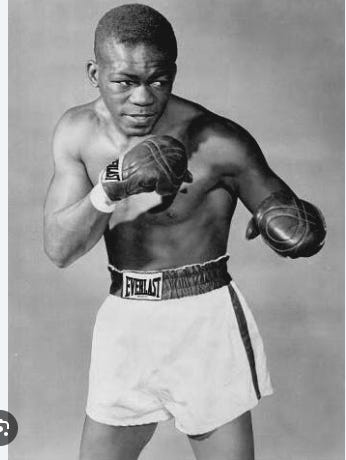
Undisputed world lightweight champion, Ike Williams
